
Helping Students Exceed Expectations
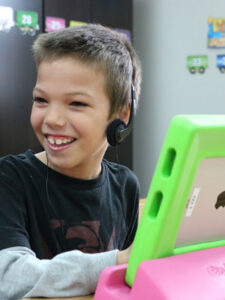 At New Horizons Academy, we believe that meaningful education begins with understanding the individual child. Every student enters the classroom with a unique combination of strengths, abilities, challenges, interests, and experiences. We recognize that children learn in different ways, develop at different rates, and require different levels of support to achieve meaningful success. That's why our curriculum is designed around the needs of each student rather than expecting every student to follow the same educational path.
Our goal is to provide students with the rich, engaging, and purposeful learning experiences found in traditional early childhood, elementary, middle, and high school programs while thoughtfully adapting instruction to meet their individual developmental and educational needs. We believe that every child deserves opportunities to explore academic subjects, discover personal interests, develop meaningful relationships, build practical skills, and experience the satisfaction of accomplishing something new.
At New Horizons Academy, education extends far beyond textbooks, worksheets, and classroom lessons. Learning happens through communication, movement, exploration, creativity, problem-solving, social interaction, and the everyday experiences that help children better understand themselves and the world around them.
We don't believe students should be defined by what they cannot do. We believe education should help them discover everything they can do.
Our curriculum emphasizes challenging each student academically, socially, physically, and behaviorally, regardless of their developmental level. By recognizing individual abilities, providing purposeful instruction, and celebrating meaningful progress, we strive to create an environment where every student can experience success and develop the confidence to reach even higher.
Individualized Learning. Extraordinary Possibilities.
Because No Two Students Learn Exactly Alike.
At New Horizons Academy, individualized education is more than an instructional strategy. It is the foundation of our entire educational philosophy.
We understand that students with special learning and developmental needs may experience challenges that require additional time, repetition, specialized teaching methods, adapted materials, or different approaches to learning. What works well for one student may not be effective for another, and a strategy that produces meaningful progress today may need to evolve as a child grows.
Our educators strive to understand how each student learns best, identify their existing strengths, and develop meaningful educational experiences that encourage continued progress.
Instruction is thoughtfully adapted to support individual learning needs while maintaining appropriate expectations and opportunities for growth. Students are encouraged to build upon what they already know, develop new abilities, and work toward goals that are meaningful to their personal development.
We believe that progress should never be measured solely by comparing one student to another. Instead, we recognize the importance of celebrating each child's individual achievements and the determination, effort, and perseverance required to reach them.
For one student, success may mean learning to recognize letters or solve a math problem. For another, it may mean communicating a need independently, participating in a group activity, developing greater physical coordination, or successfully completing a daily living task.
Different starting points. Individual pathways. Endless possibilities.
Academic Learning
Building Knowledge. Strengthening Skills. Inspiring Curiosity.
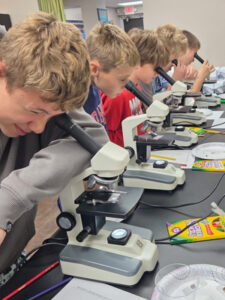 A strong academic foundation helps students better understand the world around them, develop critical thinking skills, and participate more confidently in everyday life.
Our curriculum incorporates academic learning experiences appropriate to each student's abilities, developmental level, and educational goals.
Areas of academic instruction include:
Reading & Language Arts
Students are encouraged to develop literacy and language skills that support communication, comprehension, and meaningful participation in everyday activities. Instruction may include letter recognition, phonics, vocabulary development, reading comprehension, written expression, and other foundational literacy skills.
Mathematics
Our mathematics instruction emphasizes number recognition, counting, basic operations, problem-solving, measurement, money concepts, time, and practical mathematical skills that can be applied in daily life.
Science
Through exploration, observation, discussion, and hands-on learning experiences, students are encouraged to develop curiosity about the natural world, understand basic scientific concepts, and discover how science connects to everyday experiences.
Social Studies
Students learn about themselves, their families, their communities, and the larger world. Learning experiences may introduce geography, history, citizenship, community roles, cultural awareness, and the importance of understanding and respecting others.
Communication & Vocabulary Development
Language development is incorporated throughout the educational experience, helping students strengthen their ability to understand information, communicate ideas, ask questions, express preferences, and interact meaningfully with others.
Our academic curriculum emphasizes more than memorizing information. We want students to understand how the knowledge they gain can help them make decisions, solve problems, communicate effectively, and navigate their everyday lives.
Because meaningful learning isn't simply about what students know. It's about what they can do with what they've learned.
Social & Emotional Development
Building Relationships. Growing Confidence. Discovering Belonging.
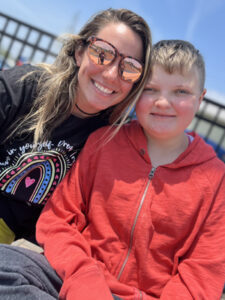 We believe that learning how to connect with others is just as important as learning academic concepts.
For many students with special learning and developmental needs, social interactions, emotional expression, communication, and understanding relationships can present unique challenges. Our curriculum recognizes these needs and provides opportunities for students to develop important interpersonal and social-emotional skills.
Throughout the school day, students are encouraged to practice skills such as:
- Developing friendships and positive relationships with classmates and adults.
- Recognizing and expressing emotions appropriately.
- Communicating personal needs, preferences, and feelings.
- Learning to share, cooperate, and participate in group activities.
- Developing patience, empathy, compassion, and respect for others.
- Understanding personal boundaries and appropriate social interactions.
- Practicing self-advocacy and learning when to ask for help.
- Developing effective strategies for managing frustration and navigating challenges.
- Building self-confidence and a positive sense of personal identity.
We believe every student deserves to experience the joy of friendship, the comfort of belonging, and the confidence that comes from being accepted for who they are.
Our classrooms provide opportunities for students to learn alongside peers, practice meaningful social interactions, and discover that everyone has strengths worth celebrating.
At New Horizons Academy, we don't simply teach students how to participate in a classroom. We help them develop the confidence and skills to participate more fully in life.
Communication & Self-Expression
Every Voice Matters. Every Connection Counts.
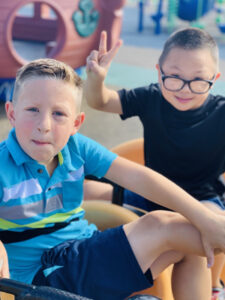 Communication is one of the most important skills a child can develop. It allows us to express our needs, share our thoughts, build relationships, make choices, and connect with the world around us.
We recognize that communication looks different for every student. Some children communicate verbally, while others may rely on gestures, signs, pictures, assistive technology, or alternative and augmentative communication methods.
Our curriculum encourages students to develop and strengthen their individual communication abilities through purposeful learning experiences and meaningful interactions throughout the school day.
Students are supported as they work toward expressing their wants and needs, understanding instructions, communicating with classmates and adults, expanding vocabulary, and participating in conversations and group activities.
Communication development is not limited to a particular classroom lesson. It is incorporated into academic instruction, play, movement, social activities, and everyday routines.
We believe that when students develop more effective ways to communicate, they gain more than a new skill. They gain greater confidence, stronger relationships, increased independence, and more opportunities to make their voices heard.
Because every child has something important to say, and every child deserves the opportunity to be understood.
Physical Development & Movement
Encouraging Movement. Building Confidence. Celebrating Progress.
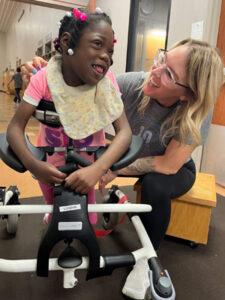 Physical development plays an important role in a child's ability to explore their environment, participate in learning activities, and develop greater independence.
Our curriculum recognizes the relationship between movement, coordination, physical awareness, and everyday functioning.
Through appropriate activities and individualized learning experiences, students are encouraged to strengthen skills involving:
- Gross motor development, including balance, coordination, and movement.
- Fine motor development, including grasping, manipulating objects, drawing, and writing.
- Body awareness and understanding movement through space.
- Physical strength, endurance, and coordination.
- Participation in recreational activities and movement-based learning.
- Practical motor skills needed for classroom activities and daily routines.
For students who require additional support, specialized interventions may complement classroom instruction and provide further opportunities to develop meaningful physical and functional abilities.
We recognize that even small improvements in movement and coordination can make a significant difference in a student's confidence, participation, and independence.
Every movement matters. Every milestone counts.
Creativity, Exploration & Hands-On Learning
Discovering New Interests. Inspiring New Possibilities.
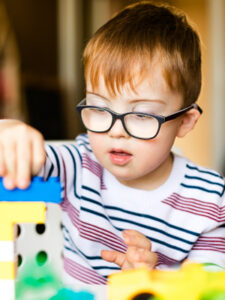 We believe that children learn best when they are actively engaged, encouraged to explore, and given opportunities to experience the world in meaningful ways.
Our curriculum incorporates creative and experiential learning activities that help students discover their interests, express themselves, and strengthen important developmental skills.
These experiences may include music, art, imaginative play, sensory exploration, movement activities, interactive lessons, and hands-on projects.
Through creative expression, students can develop communication skills, improve coordination, strengthen problem-solving abilities, and discover new ways to share their thoughts and feelings.
Hands-on learning also provides opportunities to connect classroom concepts with practical experiences, helping students better understand how the things they learn relate to the world around them.
We believe that creativity and exploration should be accessible to students of all abilities.
Because sometimes the most meaningful learning happens when a child is simply given the opportunity to discover something new.
Positive Learning Behaviors & Independence
Developing Skills for School. Building Confidence for Life.
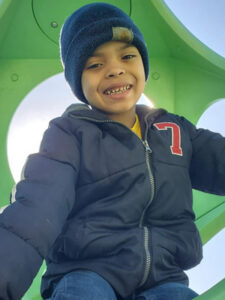 Successful learning involves more than understanding academic subjects. Students also benefit from developing the habits, behaviors, and practical skills that allow them to participate meaningfully in educational and everyday environments.
Our curriculum incorporates opportunities to strengthen attention, organization, self-regulation, responsibility, and increasing independence.
Depending on their individual needs and abilities, students may work toward goals such as:
- Following directions and understanding classroom expectations.
- Developing attention and participation skills.
- Taking turns and participating appropriately in group activities.
- Completing tasks with increasing independence.
- Managing transitions between activities and environments.
- Developing problem-solving and decision-making abilities.
- Learning appropriate ways to request assistance.
- Strengthening personal responsibility and self-advocacy.
- Practicing daily routines and functional life skills.
- Developing confidence when approaching unfamiliar tasks or challenges.
We understand that independence is not achieved in exactly the same way for every student. For some, it may mean completing a classroom assignment without assistance. For others, it may involve learning to communicate a preference, make a choice, manage a personal routine, or participate more actively in daily activities.
Our goal is to encourage meaningful progress while respecting each student's individual abilities and support needs.
We believe independence begins with opportunity, grows through encouragement, and develops through meaningful experiences of success.
Learning That Extends Beyond the Classroom
Preparing Students for Today, Tomorrow, and the Possibilities Ahead.
At New Horizons Academy, we believe education should help prepare students for meaningful participation in the world beyond school.
As students grow and develop, our curriculum increasingly emphasizes the practical application of academic knowledge, communication abilities, social skills, and personal independence.
Learning opportunities may include functional academics, daily living skills, community awareness, personal responsibility, vocational exploration, and other experiences that support students as they prepare for future opportunities.
Through our Academic & Career Readiness and PACE Transition programs, students may have opportunities to develop practical skills and explore experiences that support greater independence and meaningful involvement in their communities.
We recognize that each student's future will be different. Some may pursue additional educational opportunities, others may develop vocational interests or employment-related skills, and others may focus on strengthening daily living abilities and community participation.
There is no single pathway that defines success for every student.
Our responsibility is to recognize each student's individual potential and help provide the educational experiences, encouragement, and support that prepare them for the possibilities ahead.
Skills for school. Skills for work. Skills for life.
Building an "I Can!" Attitude
Confidence Changes Everything.
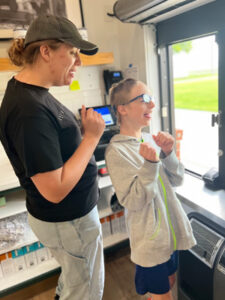 Perhaps one of the most important things we strive to develop at New Horizons Academy cannot be measured by a test score or captured on a report card.
It's the moment a child begins to believe in themselves.
It's the confidence that comes from mastering a new skill after weeks or months of practice. It's the pride of completing a task independently for the first time. It's the excitement of discovering a new ability, making a friend, or accomplishing something that once seemed out of reach.
We believe these experiences are essential to a child's educational journey.
Our curriculum is designed not only to help students acquire knowledge and develop skills, but also to encourage persistence, resilience, curiosity, self-confidence, and a willingness to embrace new challenges.
We want students to recognize their strengths, take pride in their accomplishments, and understand that challenges do not diminish their worth or define their potential.
Every success, regardless of its size, becomes another opportunity to reinforce a powerful belief:
"I can learn. I can grow. I can accomplish great things."
And when students begin to believe in themselves, an entirely new world of possibilities can begin to open.
A Curriculum Built Around Possibility
Every Student. Every Ability. Every Opportunity.
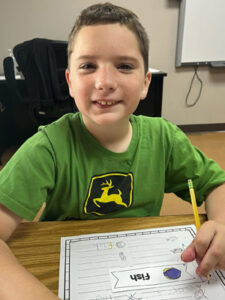 At New Horizons Academy, our curriculum reflects our unwavering belief that every child deserves an educational experience that recognizes their individuality, challenges them appropriately, and celebrates their progress.
We believe education should nurture the whole child, strengthen meaningful skills, inspire curiosity, develop confidence, and provide opportunities for greater independence.
Most importantly, we believe that a child's challenges should never prevent us from recognizing their potential.
Whether a student is learning their first words, mastering an academic concept, developing a friendship, strengthening physical abilities, or preparing for greater independence, we are committed to creating meaningful opportunities for growth.
Because at New Horizons Academy, we're not simply teaching lessons. We're helping students discover their strengths, build confidence, embrace possibilities, and reach new horizons.